 Photo by Silken.
Our first amphibious ride. We rode to Ross Island, camped overnight, and returned to civilization the next day.
It started to rain just as we reached the river. We convinced ourselves that we knew what we were doing and floundered across.
All the rides, people, and supplies made it to the island, although some were more submerged than planned. Once we arrived, we agreed that it was one of the stupidest things that we had ever done.
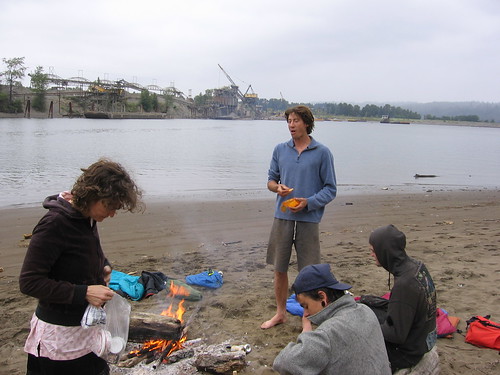
This new world was very entertaining. We looked for treasure, sang around the fire, swam, and ate and drank well. Sandy made a spooky burning will-o-the-wisp raft and towed it around the river, and the prince of the hydrochuds visited.
It rained all night, which means that there were floaters in the river on our way back due to the "combined sewage outflow".
Riding the Willamette made us feel free and strong.
The Swamp Thing has adjustable nacelles - high on land, so the bike can lean, low on water, so the paddlewheel is halfway in.
These are not the first nautical adventures of the Swamp Thing; someone once hucked it off of a bridge into a swamp. We were tipped off about its general location, but we had to play Claw Machine with our grappling hook before we snagged it.
Photo by Silken.
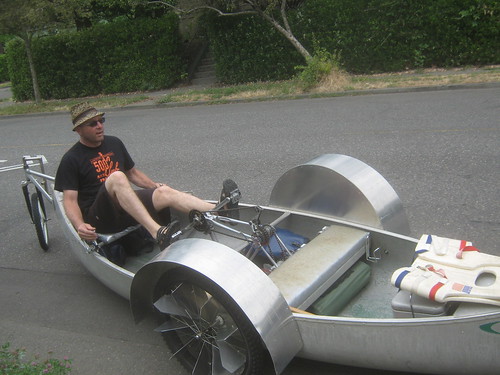
The Hesperus is a tadpole trike on land and a jetboat in the water.
A squirrel fan from a furnace is used as an impeller.
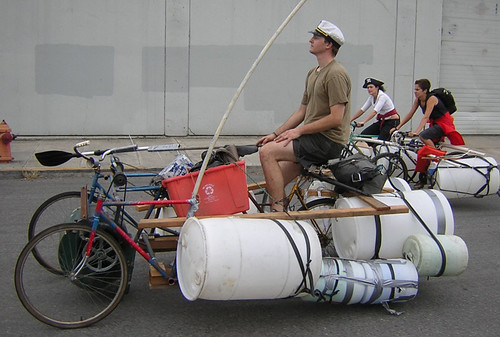 Photo by Silken.
Damn, I love this trike. It eats rear wheels, though. I took it
on a test float to figure out where to put the pontoons for the
right impeller depth, and I spent two wheels getting back home.
Photo by Silken.
Damn, I love this trike. It eats rear wheels, though. I took it
on a test float to figure out where to put the pontoons for the
right impeller depth, and I spent two wheels getting back home.

 Photos by Silken.
 Photo by Silken.
Denk and ShayNayNay lashed their bikes together with PVC pipes and
inner tubes. I still don't understand how this was rideable on land,
because there was no steering linkage. I guess they just rode
within the slop.
Photo by Silken.
Denk and ShayNayNay lashed their bikes together with PVC pipes and
inner tubes. I still don't understand how this was rideable on land,
because there was no steering linkage. I guess they just rode
within the slop.
 Photo by Silken.
 Photo by Silken.
Last ride of the Little Big Man.
Ninja made the Little Big Man years ago, and then left it in B's yard. He'd fix it up whenever he was in town and ride it until something broke down again. Then he'd throw it back on the pile and tell B to keep an eye on it. We tried to get rid of it. We gave it away and it came back. It sat on the curb for a month, but everything worth taking was already taken and the scrappers didn't visit for some reason. We gave it to someone from Shift to raffle off, and the raffle winner wrote me to ask for help in putting some wheels and a chain on it, then left it on the sidewalk right where it came from before I could tell her to get the hell away!
Finally, B had the perfect idea of taking it to Ross Island and leaving it there. We have seen the last of it. Now the hydrochuds worship it at night.
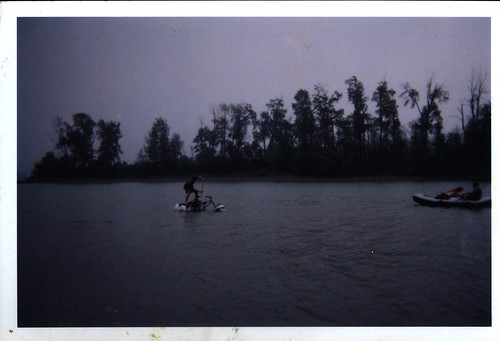 Photo by Misty Cummings.
The Hesperus, the Swamp Thing, the Little Big Man, Sandy's unicycle, Denk and Shanaynay's, um, thing, and Peter's bag.
Peter's bag was a plastic balloon with a kraft paper covering that had been a cargo cushion from a truck. It didn't float very well after the paper got waterlogged, but B and Avery got to sleep in it.
Sandy had an innertube hanging off of his shoulders by suspenders, and tethered the unicycle to that.
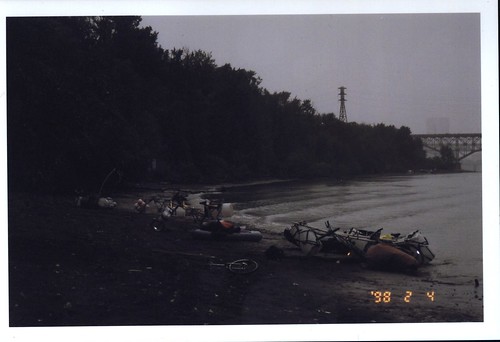 Photo by Misty Cummings.
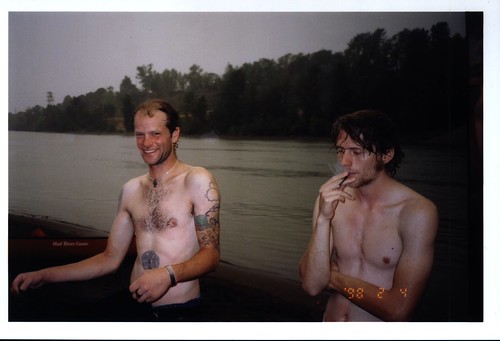 Photo by Misty Cummings.
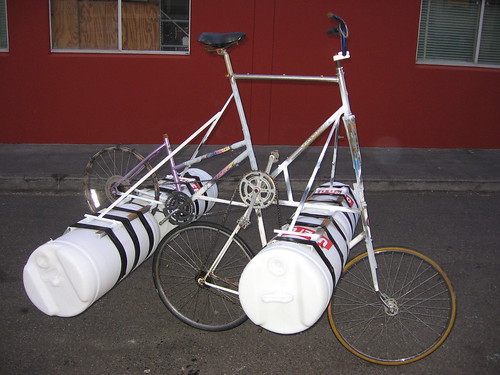 The Willamaconda has a height-adjustable paddlewheel.
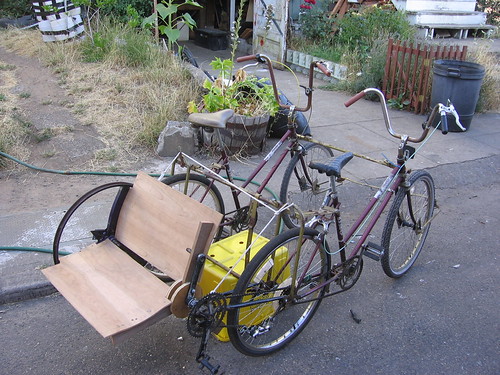
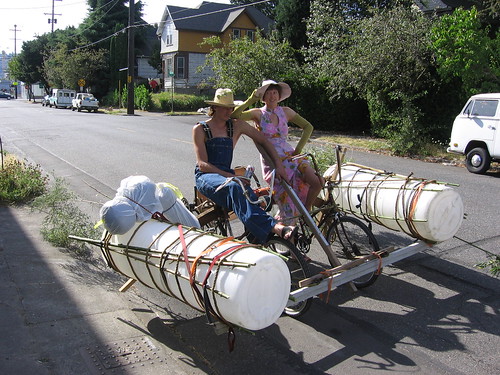 The S.S. Walter S. Mondale.
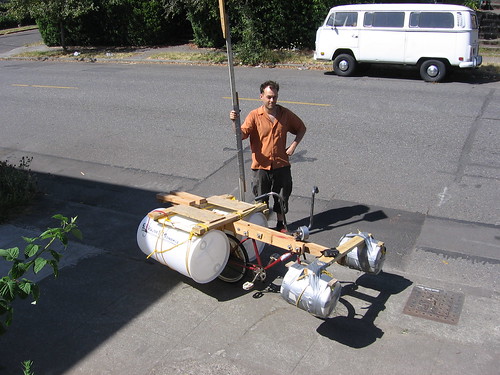 Thud brought the Swamp Thing out again.
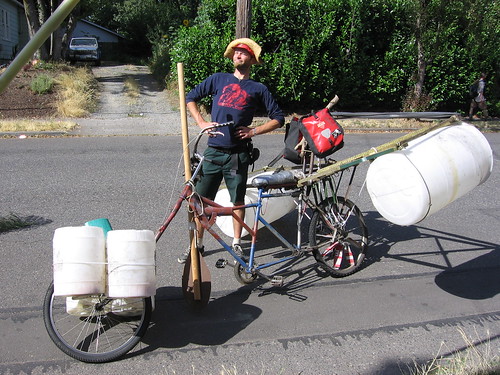
 Most of us spent weeks inventing adjustable pontoons and drivetrains
to keep
our paddlewheels half submerged. Krack just slapped some
barrels on the old Family Truxter. Only a few inches of the rear wheel
were out of
the
water, and it's the fastest bike in the fleet.
Most of us spent weeks inventing adjustable pontoons and drivetrains
to keep
our paddlewheels half submerged. Krack just slapped some
barrels on the old Family Truxter. Only a few inches of the rear wheel
were out of
the
water, and it's the fastest bike in the fleet.
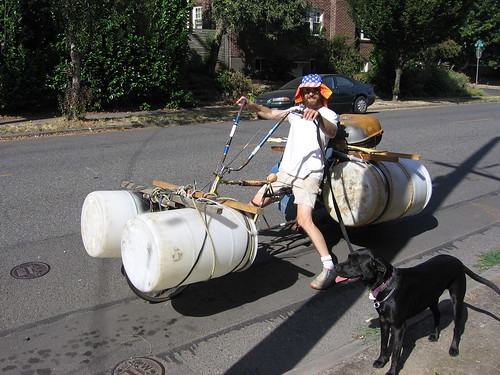 Thandi and Dirty lashed a hunk of styrofoam to their basket and swam
it across.
Thandi and Dirty lashed a hunk of styrofoam to their basket and swam
it across.
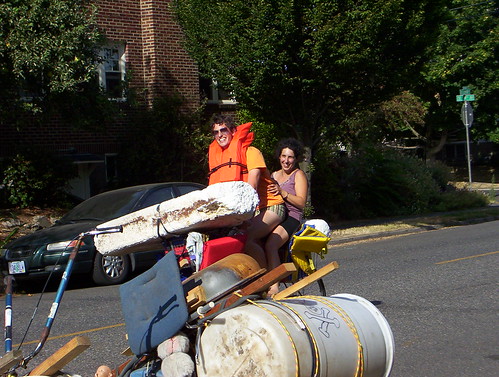 Photo by Lance E. Pants.
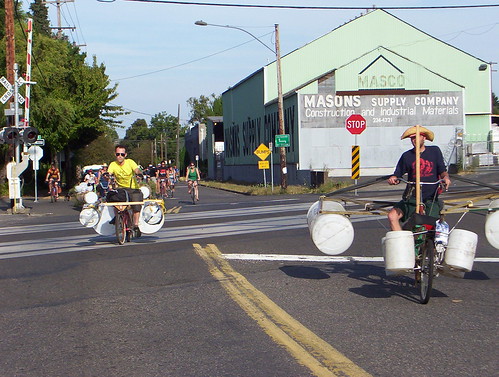 Photo by Lance E. Pants.
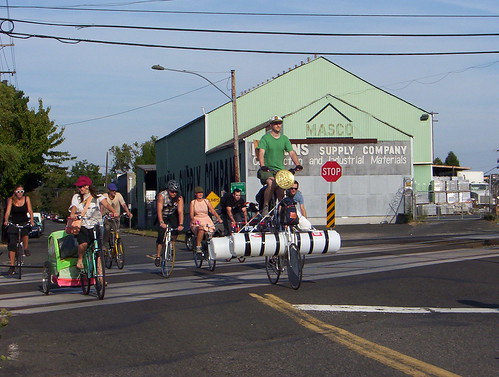 Photo by Lance E. Pants.
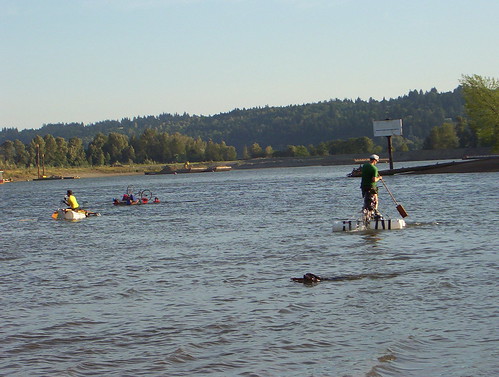 Photo by Lance E. Pants.
Most of us propelled our rides by attaching paddles to our rear
spokes, with an oar for steering. These aquachoppers tend to veer to
the side and need correction every so often, since the paddles are all
tilted in one direction.
Photo by Lance E. Pants.
Most of us propelled our rides by attaching paddles to our rear
spokes, with an oar for steering. These aquachoppers tend to veer to
the side and need correction every so often, since the paddles are all
tilted in one direction.
 Photo by Lance E. Pants.
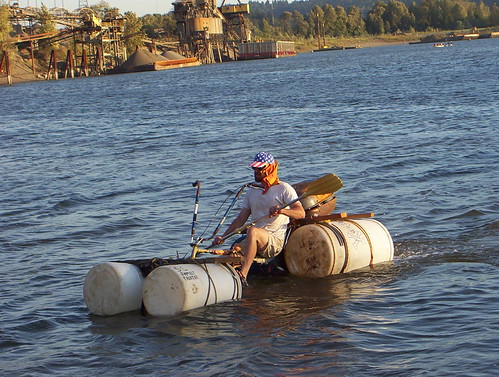 Photo by Lance E. Pants.
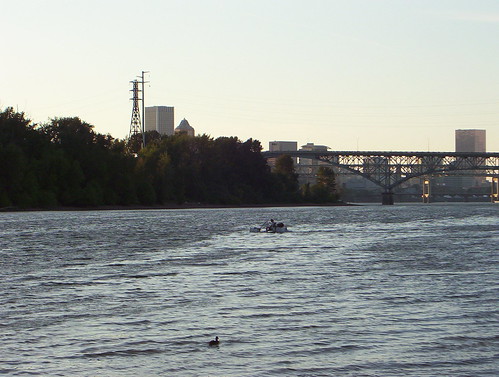 Photo by Lance E. Pants.
Every time we have been on the river, there has been a wind from downstream
that was stronger than the current. On the way back, we hauled the
bikes to the tip of the island and held our tarps out to catch the
wind back. Apparently the nautical term for this is the "sail".
Photo by Lance E. Pants.
Every time we have been on the river, there has been a wind from downstream
that was stronger than the current. On the way back, we hauled the
bikes to the tip of the island and held our tarps out to catch the
wind back. Apparently the nautical term for this is the "sail".
 Photo by Thud.
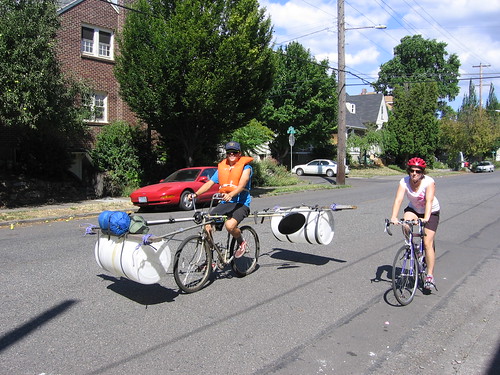
Last time out, I hadn't put the paddlewheel blades on the Ross Island Explorer yet, only the half-inch angle iron bases. The paddlewheel was a little high in the water, too. With no centerboard, my body as a sail on top of that tallbike, and a wind from downstream which was faster than the current, I ended up being blown off course to Hardtack Island.
Along with adding the blades, I turned the rear pontoons upside down so I could uncap them and take in some water, which lowered the paddlewheel. It is okay to open a old chemical drum in the river if you're over a toxic waste dump, just upstream of a Superfund site, and looking at a sewer pipe five feet in diameter, though.
The blades worked really well; I broke six spokes this year and the wheel is toast. This is unfortunate because I had to clamp and unclamp those damn vice grips 64 times just to tack them on.
Also new are the cables between the lower dropouts and the pontoon stays. These improved the handling on land, stopped the chains from getting knocked off when everything flexed, and reduced stress on the rear wheel.
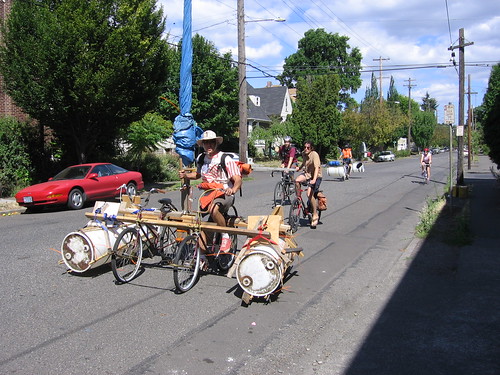
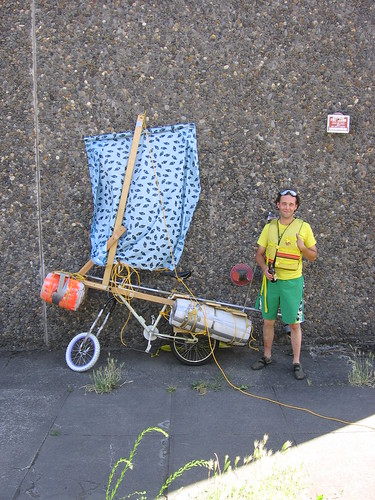
 After we had
discovered wind power on the way back last time, Big B had added a
sail to the Willamaconda with a mast
and a boom and everything, and we had already taken it dirt boating a
few times.
After we had
discovered wind power on the way back last time, Big B had added a
sail to the Willamaconda with a mast
and a boom and everything, and we had already taken it dirt boating a
few times.
 (Yes. Dirt boating. No pedaling is required. But let us return to
the adventures of the briny deep.)
(Yes. Dirt boating. No pedaling is required. But let us return to
the adventures of the briny deep.)

 Photos by Silken, Krack.
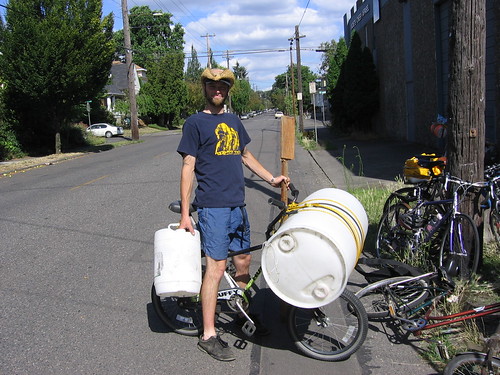
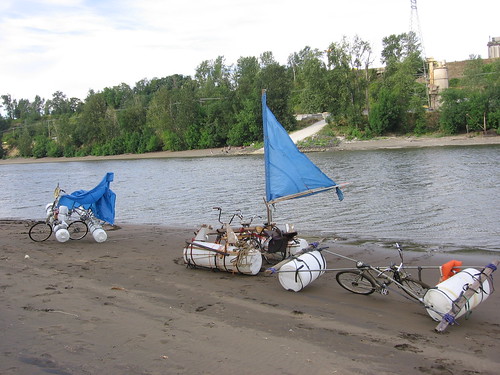
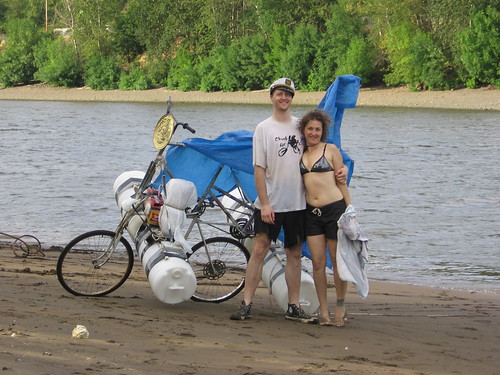 Ross Island is an industrial island. It used to be two islands; the
other was Hardtack Island. Ross Island Sand and Gravel connected the
two with a landbridge to form a lagoon, then put two toxic waste dumps
in the water. Why not?
Hanford Nuclear Reservation is upstream of us on the Columbia, and no
man alive knows how to clean that place up.
Ross Island is an industrial island. It used to be two islands; the
other was Hardtack Island. Ross Island Sand and Gravel connected the
two with a landbridge to form a lagoon, then put two toxic waste dumps
in the water. Why not?
Hanford Nuclear Reservation is upstream of us on the Columbia, and no
man alive knows how to clean that place up.
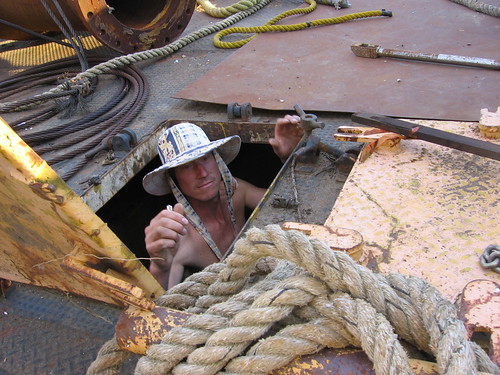
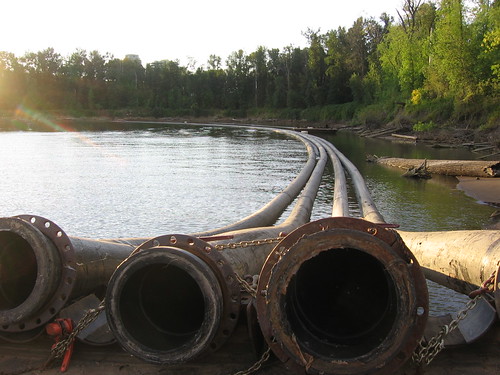
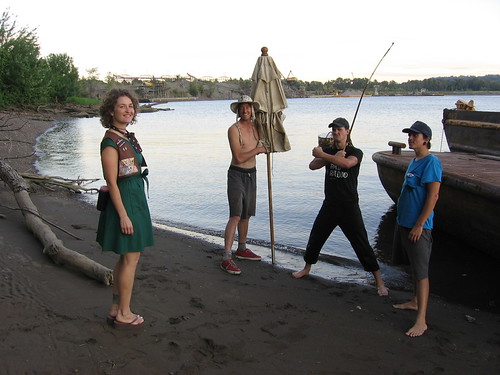
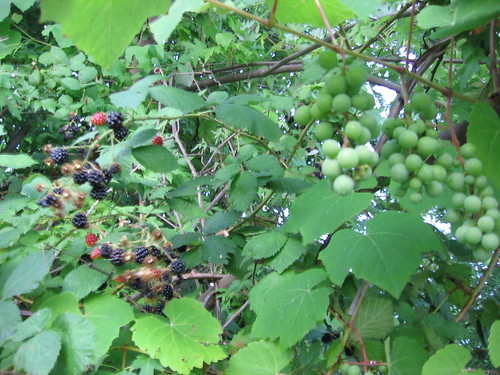
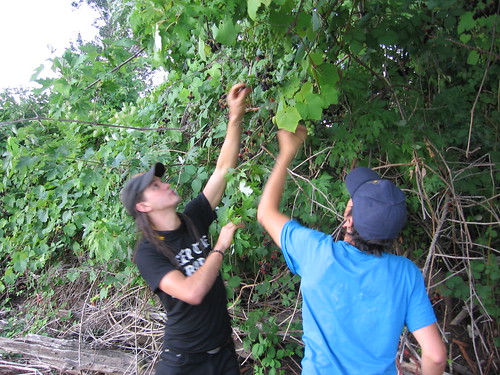 The island was an idyllic paradise. We saw geese, ducks,
and an osprey, and saw the tracks of deer, raccoons, and otters. We
hunted the waterfowl without success since we had forgotten to bring
weapons.
The island was an idyllic paradise. We saw geese, ducks,
and an osprey, and saw the tracks of deer, raccoons, and otters. We
hunted the waterfowl without success since we had forgotten to bring
weapons.
 I like the night shots of the amphibious craft. The lights of
downtown Portland are in the distance.
I like the night shots of the amphibious craft. The lights of
downtown Portland are in the distance.
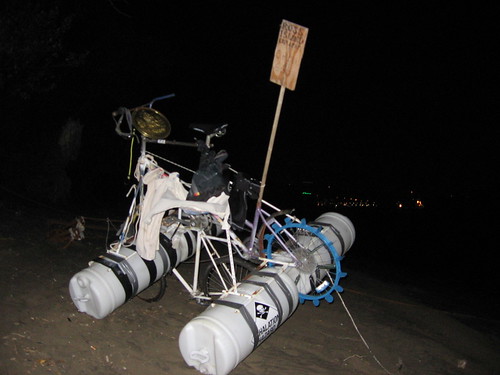
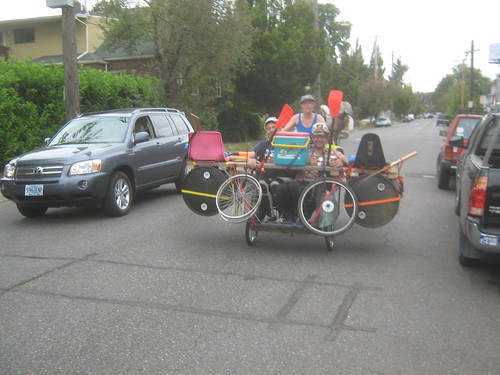 Must have a tallbike in the fleet somewhere.
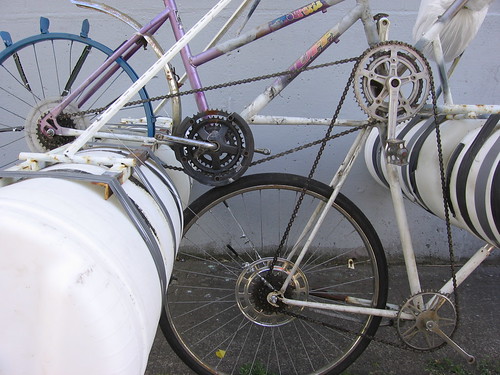
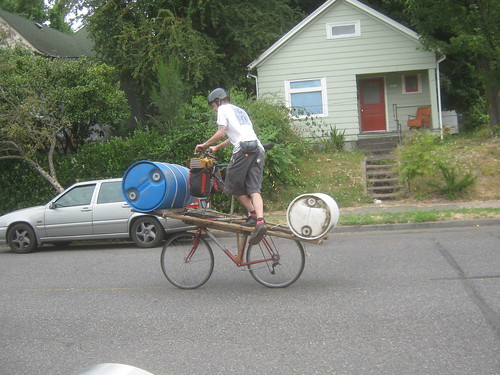 Also must have pontoons duct taped to rusty frames.
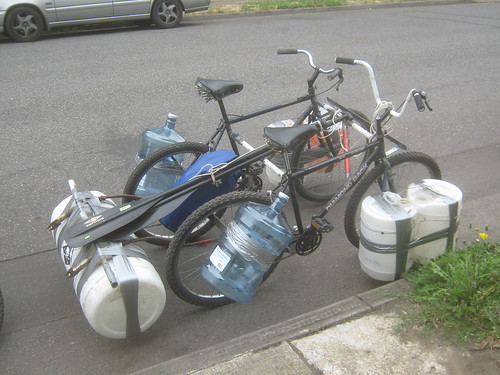
Big B. pulled the Willamaconda out again from where it had been rusting in his yard, and made a new frame and paddlewheel for it. The wood from the previous trip had been either scavenged to build up his house or had rotted off in the winter rain.
Riding partially disassembled on land is less fun, but it's a smart idea, because we had to get over a bollard and through some narrow spots. Saves on duct tape to truss up the sagging pontoons after they've been bashed around.

The New Ross Island Explorer. I took off the paddlewheel and added a propleller, something I've always wanted to do. This was a challenge, because it required a right angle gear of some kind. It also required a somewhat hydrodynamic screw, which this propeller was not. The sheen of my greasy wake as I slowly pedaled myself backwards while concentrating on balancing myself within the center of gravity of my reduced pontoon footprint was encouraging, though, between getting bucked off by the diving prop.
Some people give me grief when I mention that greasy sheen, but they're the same people who are aghast that I put my body in the Willamette. Superfund site, underwater toxic waste dump which was mistakenly mined, two-stroke outboard motors, floaters from the combined sewer outflow? Paper mill? Leaky cars on the bridges? The otters didn't mind me.

The right-angle drive came from American Science and Surplus. I don't know how many watts it could reliably take, but I figured by the time my work got through the triple rusty tallbike chain, the secondary chain, and the gummy old bottom bracket that had been sitting in my yard for years, it wouldn't be a problem.
I initially tried a bevel gear from an angle grinder, which is ideal in a lot of ways, and gave me the opportunity to saw open an angle grinder. Unfortunately, it was sensitive to gear placement, and my caveman technology had too much slop. Kludges like an 8mm bearing on a 5/16 inch shaft wouldn't cut it, never mind that universal joint.

Jay and Jessica brought The Sea Nymph from San Francisco. It can be humbling to hang out with Jay because he's a real fabricator and makes rocket-powered aluminum tallbikes for Cyclecide that can jump the Bay, while we don't know what we're doing and our bikes are made out of trash.
He spent money, though, which makes us feel better. The differential comes from Northern Tool, and there are some slick waterproof brass and nylon bushings to let the axle pierce the hull.
 The Sea Nymph is also impressive because it not only has steering, but
steers the same on land and water.
The Sea Nymph is also impressive because it not only has steering, but
steers the same on land and water.

The flange of the Sea Nymph's hub broke off of the body, so Jay joined them with some angle iron.
Wouldn't be a Chunk ride unless something had to welded together at the last minute, cooking all the grease out of it. It made us feel better to see that sweet machine needing a quick and dirty fix to keep it rolling. I also want to point out the respirator to any young hackers in the audience. I wish I had put one one before sticking my face near burning chrome in my foolish youth.
 Most of our bikes were upside down at one time or another.
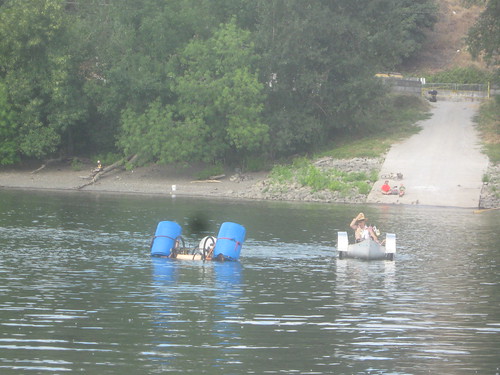
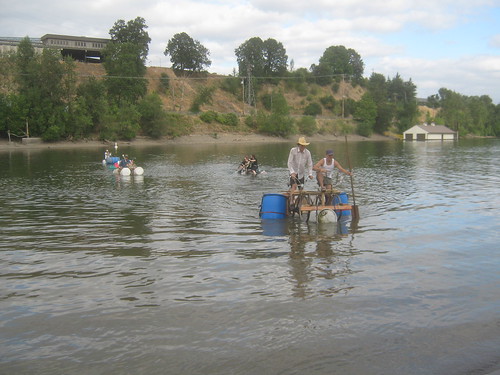

 Photo by Mykle Hansen.
 Photo by Mykle Hansen.
 Photo by Libby Borte.
Not where I expected it to fail.
Photo by Libby Borte.
Not where I expected it to fail.

